

Flow Chemistry Market size Worth USD 4.40 Billion by 2032 – Exclusive Report by Maximize Market Research
Flow Chemistry Market
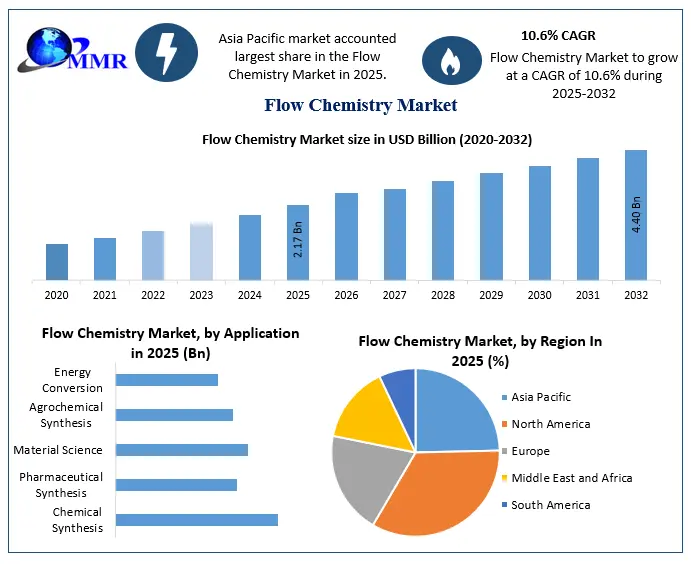
The Flow Chemistry Market was valued at USD 2.17 billion in 2025 and is projected to reach USD 4.40 billion by 2032, growing at a CAGR of 10.6% from 2026–2032.
Flow Chemistry innovation accelerates sustainable API production, discover the future of chemical manufacturing with Maximize Market Research!”
ROCKVILLE , MD, UNITED STATES, March 16, 2026 /EINPresswire.com/ -- According to Maximize Market Research, the Flow Chemistry Market size is projected to reach USD 4.40 billion by 2032 from USD 2.17 billion in 2025, registering a CAGR of 10.6% during the forecast period.— Maximize Market Research
Get Full PDF Sample Copy of Report: (Including Full TOC, List of Tables & Figures, Chart) @ https://www.maximizemarketresearch.com/request-sample/201415/
The report, titled “Flow Chemistry Market Size by Reactor, Application, and Region – Segment-Level Market Assessment, Growth Opportunity Analysis, Competitive Mapping & Forecast to 2032”, offers a comprehensive analysis of continuous flow chemistry adoption, microreactor technology advancements, and sustainable chemical manufacturing processes across the global landscape.
Flow Chemistry Market Size & Forecast
Market Size Available for Years: 2025–2032
2025 Market Size: USD 2.17 billion
2032 Projected Market Size: USD 4.40 billion
CAGR (2026–2032): 10.6%
The report highlights the growing adoption of Continuous Flow Chemistry in Pharmaceutical Manufacturing, Microreactor Technology for Chemical Processing, and Flow Chemistry Technology for Sustainable Manufacturing as key drivers shaping the global market landscape.
Flow Chemistry Market Insights
Innovation and Process Efficiency: Flow chemistry, also known as continuous flow or microreactor technology, leverages a continuous stream of reactants through engineered flow reactors rather than traditional batch processes. This approach allows enhanced control over reaction conditions, faster reaction times, higher product yields, and improved process safety. The market is witnessing rapid adoption of Advanced Flow Chemistry Systems for Chemical Synthesis, which enable efficient and scalable chemical manufacturing while supporting environmental sustainability.
Industrial Applications: The pharmaceutical sector is the largest adopter, leveraging flow chemistry for the synthesis of active pharmaceutical ingredients (APIs) and drug intermediates. Precise control over reaction parameters improves first-pass yield and accelerates drug development cycles. Additionally, chemical synthesis, specialty chemicals, agrochemical synthesis, material science, and energy conversion are expanding their adoption of continuous flow reactors due to improved process efficiency, reduced waste, and enhanced scalability.
Technological Advancements: The integration of automation, real-time monitoring, and artificial intelligence (AI) is transforming flow chemistry into autonomous chemical manufacturing platforms. Microreactors, modular continuous systems, and process intensification techniques (multi-step reactions in a single system) allow manufacturers to optimize reaction conditions, reduce intermediate storage, and minimize energy consumption, positioning flow chemistry as a critical tool for industrial efficiency.
Key Drivers Accelerating Continuous Flow Chemistry for Sustainable API Production
Rising Adoption of Continuous Flow Reactors for API Production: Flow chemistry improves reproducibility and reduces batch-to-batch variability, addressing the challenges of increasingly complex pharmaceutical molecules.
Sustainable Chemical Manufacturing Demand: Companies are focusing on green chemistry principles, reducing hazardous waste and solvent consumption through microreactor-based continuous processes.
Process Efficiency and Cost Optimization: Continuous systems enable faster reactions, improved yields, and lower operational costs, enhancing productivity in chemical and pharmaceutical manufacturing.
Technological Integration: AI-driven reaction optimization, predictive monitoring, and modular flow systems enhance throughput, operational control, and scalability.
Overcoming Barriers in Continuous Flow Chemistry: Challenges Slowing Sustainable API Production
Engineering Complexity in Process Translation: Transitioning batch reactions to continuous flow requires process redesign, catalyst selection, and microreactor configuration, which can slow adoption.
Capital and Expertise Requirements: High initial investment in continuous flow systems, automation, and inline monitoring, coupled with a shortage of trained personnel, poses a barrier for small- and medium-sized manufacturers.
Regulatory Adaptation: Existing regulations for chemical and pharmaceutical manufacturing are often designed for batch processes, requiring extensive validation when implementing flow chemistry systems.
Unlocking Growth in Flow Chemistry: AI-Driven, Modular, and Personalized API Production
Digitalization of Continuous Flow Processes: Integration of AI, machine learning, and real-time analytics allows for predictive optimization, reaction outcome modeling, and autonomous chemical synthesis.
Modular Flow Manufacturing Platforms: Compact, flexible, and decentralized production units allow manufacturers to scale production closer to target markets while reducing supply chain risks.
Personalized and Small-Batch Pharmaceutical Production: Flow chemistry enables efficient small-batch production of high-value molecules for precision medicine and rare disease therapies.
Expansion in Specialty Chemicals and Advanced Materials: The ability to perform controlled reactions supports the production of catalysts, nanomaterials, and energy-related compounds.
Emerging Flow Chemistry Trends Powering Sustainable and Scalable API Synthesis
AI-Driven Autonomous Flow Chemistry Platforms Accelerate Precision Production: The integration of artificial intelligence and machine learning in continuous flow chemistry is transforming traditional chemical synthesis. Self-optimizing reactors allow predictive reaction modeling, minimize human intervention, and boost throughput, making Continuous Flow Chemistry in Pharmaceutical Manufacturing faster, safer, and highly efficient.
Microreactor Technology Innovations Enable Complex and High-Yield Reactions: Advancements in Microreactor Technology for Chemical Processing are enhancing heat and mass transfer, enabling the safe execution of highly exothermic and multi-step reactions. This innovation supports Flow Chemistry Technology for Sustainable Manufacturing by reducing waste, energy use, and process variability.
Process Intensification and Modular Platforms Drive Scalable, Sustainable API Production: The adoption of modular continuous flow systems and process intensification techniques allows simultaneous multi-step reactions within a single platform, reducing production time and intermediate storage. These innovations make Flow Chemistry Market growth more agile, sustainable, and aligned with the rising demand for personalized and small-batch API production.
Flow Chemistry Market Segmentation: Microreactors and Chemical Synthesis Driving Next-Gen Sustainable Manufacturing
Flow Chemistry Market is strategically segmented by reactor and application, with microreactors leading innovation through enhanced heat and mass transfer, enabling precise, scalable, and safe chemical synthesis. On the application front, chemical synthesis dominates, driven by the demand for high-yield, reproducible, and sustainable production processes. These segments highlight the transformative potential of Continuous Flow Chemistry in Pharmaceutical Manufacturing and Flow Chemistry Technology for Sustainable Manufacturing, promising efficiency, modular scalability, and next-generation process optimization.
Get Full PDF Sample Copy of Report: (Including Full TOC, List of Tables & Figures, Chart) @ https://www.maximizemarketresearch.com/request-sample/201415/
By Reactor
Tabular Reactor
Microreactor
Oscillatory Flow Reactor
Packed-Bed Reactors
Droplet-Based Reactor
Photochemical Reactors
Others
By Application
Chemical Synthesis
Pharmaceutical Synthesis
Material Science
Agrochemical Synthesis
Energy Conversion
Others
Flow Chemistry Market Innovations: 2023–2025 Breakthroughs, Collaborations, and Next-Gen Reactor Launches
In 2025, ThalesNano Inc. unveiled the upgraded H‑Cube Pro continuous flow reactor, boosting scalable API synthesis and precision chemical manufacturing. In May 2025, Syrris Ltd. partnered with Waters Corporation to integrate advanced analytics and process control into flow chemistry platforms. In late 2023, Vapourtec Ltd. launched a CSTR cascade reactor system for multi-reactor continuous processing. In 2023, Corning Incorporated expanded its Lab Reactor System 2 portfolio, enabling safer, high-throughput, and scalable chemical synthesis.
Flow Chemistry Market Insights: Asia Pacific and Europe Driving Next-Gen Sustainable API Production
Asia Pacific Leads Global Flow Chemistry Innovation: China, India, and Japan adopt microreactor-based chemical synthesis and AI-integrated continuous flow platforms, enabling scalable, high-throughput API production and establishing the region as a sustainable manufacturing powerhouse.
Europe Drives Advanced Process Intensification: Germany, France, and the UK focus on AI-driven modular flow systems, optimizing efficiency, reproducibility, and green chemical production, positioning Europe as a hub for next-generation Flow Chemistry Technology.
Regional Synergies Accelerate Global Flow Chemistry Adoption: Combining skilled talent, regulatory support, and modular continuous platforms, Asia Pacific and Europe lead sustainable API synthesis, multi-step reactions, and innovative Flow Chemistry Technology for Pharmaceutical Manufacturing.
Flow Chemistry Market Competitive Landscape: Top Innovators Driving AI-Powered Sustainable Manufacturing
Flow Chemistry Market competitive landscape is rapidly evolving as ThalesNano Inc., Syrris Ltd., Vapourtec Ltd., and Corning Incorporated pioneer modular continuous platforms while innovators like Uniqsis Ltd., FutureChemistry Holding BV, HEL Group, and Chemtrix B.V. advance microreactor‑based chemical synthesis. AM Technology and Little Things Factory GmbH are differentiating through high‑throughput, AI‑integrated systems, collectively driving Continuous Flow Chemistry in Pharmaceutical Manufacturing and Flow Chemistry Technology for Sustainable Manufacturing.
Flow Chemistry Market, Key Players:
ThalesNano Inc.
Syrris Ltd.
Vapourtec Ltd.
Corning Incorporated
Uniqsis Ltd.
FutureChemistry Holding BV
HEL Group
Chemtrix B.V.
AM Technology
Little Things Factory GmbH
Continuus Pharmaceuticals
Lonza Group Ltd.
Microinnova Engineering GmbH
Biotage AB
CEM Corporation
H.E.L Group
DSM Pharmaceutical Products
PDC Machines Inc.
Ehrfeld Mikrotechnik BTS GmbH
Royal Dutch Shell plc
Advanced Chemistry Development, Inc. (ACD/Labs)
Chemtrix B.V.
Novartis International AG
Cambridge Reactor Design Ltd.
Avantium Technologies B.V.
Get access to the full description of the report @ https://www.maximizemarketresearch.com/market-report/flow-chemistry-market/201415/
FAQs:
How is AI transforming Continuous Flow Chemistry in pharmaceutical manufacturing?
Ans: AI integration in continuous flow reactors enables predictive reaction modeling, real-time monitoring, and autonomous optimization, reducing human intervention while improving throughput, reproducibility, and efficiency. This makes Flow Chemistry Technology for Sustainable Manufacturing faster, safer, and ideal for complex API production.
Why are microreactors considered the most innovative segment in the Flow Chemistry Market?
Ans: Microreactors enhance heat and mass transfer, enabling high-yield, multi-step, and safe chemical synthesis. Their adoption drives modular, scalable, and sustainable production, positioning microreactor-based systems as the backbone of next-generation continuous flow platforms.
Which regions are leading the global Flow Chemistry Market, and why?
Ans: Asia Pacific dominates due to rapid adoption of AI-integrated continuous flow platforms in China, India, and Japan, while Europe excels through modular flow systems and process intensification. Both regions are driving sustainable API production and shaping the global Flow Chemistry Market for Pharmaceutical Manufacturing.
Analyst Perspective:
Flow Chemistry sector is poised for robust growth, driven by AI-integrated microreactor innovations, modular platforms, and sustainable API production. Leading players like ThalesNano, Syrris, Vapourtec, and Corning are spearheading collaborations, technology upgrades, and strategic expansions across Asia Pacific and Europe. Rising adoption, process intensification, and green chemistry trends position the market for high returns, competitive differentiation, and long-term innovation-driven value creation.
Related Reports:
Life Science Reagents Market: https://www.maximizemarketresearch.com/market-report/global-life-science-reagents-market/32066/
Chemistry 4.0 Market: https://www.maximizemarketresearch.com/market-report/chemistry-4-0-market/171629/
Lab Automation in Analytical Chemistry Market: https://www.maximizemarketresearch.com/market-report/global-lab-automation-in-analytical-chemistry-market/22186/
Top Reports:
Global Radiofrequency Identification Market
Solar Photovoltaic Glass Market
About Maximize Market Research – Flow Chemistry Sector:
Maximize Market Research is a leading market research and business consulting firm specializing in the Material & Chemical domain. With deep expertise in Flow Chemistry, we empower clients with actionable insights, technology adoption strategies, and competitive intelligence to drive innovation, sustainable chemical manufacturing, and process optimization.
Our growth-driven research initiatives make us a trusted partner for top global chemical and pharmaceutical companies. We provide comprehensive analysis on continuous flow reactors, microreactor technology, AI-integrated platforms, and sustainable API production, enabling clients to maximize efficiency, scalability, and profitability in the evolving Flow Chemistry Market.
Lumawant Godage
MAXIMIZE MARKET RESEARCH PVT. LTD.
+ +91 96073 65656
email us here
Visit us on social media:
LinkedIn
Instagram
Facebook
X
Legal Disclaimer:
EIN Presswire provides this news content "as is" without warranty of any kind. We do not accept any responsibility or liability for the accuracy, content, images, videos, licenses, completeness, legality, or reliability of the information contained in this article. If you have any complaints or copyright issues related to this article, kindly contact the author above.
