

Palisades Therapeutics Secures European Composition‑of‑Matter Patent for TPR1, Now in Ph 2 USDA Citrus Greening Trials

Pop Test/Palisades Therapeutics
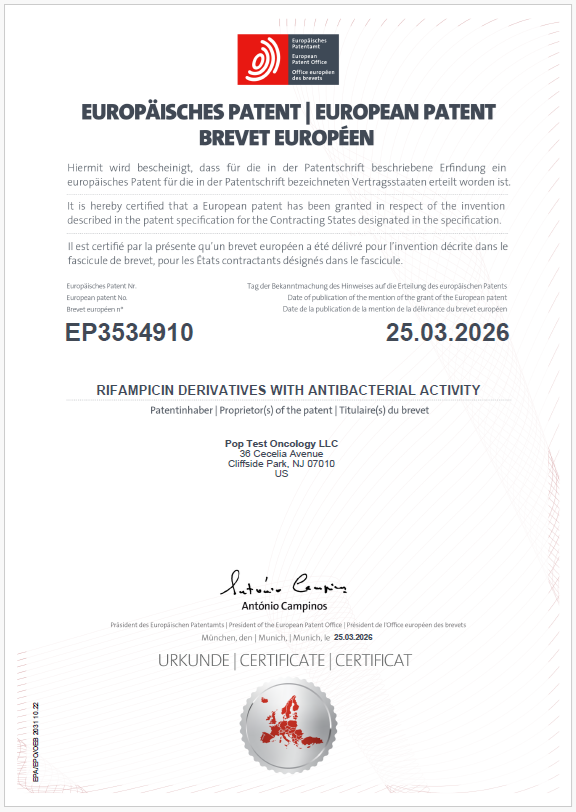
EPO Patent Certificate
USDA‑funded grove studies of TPR1 target a multibillion‑dollar crop loss problem while the new EPO patent locks in protection for the core molecule
a USDA‑selected compound already in Ph 2 grove trials, backed by EPO composition‑of‑matter protection, puts us in a unique position to deliver the first field‑ready antibacterial for citrus greening”
CLIFFSIDE PARK, NJ, UNITED STATES, April 14, 2026 /EINPresswire.com/ -- Pop Test Oncology LLC, operating as Palisades Therapeutics, today announced that the European Patent Office (EPO) has granted European Patent EP 3 534 910 B1, covering TPR1 and related rifampicin‑derived compounds (PT159, PT160) as novel compositions of matter, together with their pharmaceutical compositions and kits. The patent provides European composition‑of‑matter protection for TPR1 and key derivatives, including broad claims on dosage forms suitable for systemic and topical delivery. — Randi Altschul, CEO
This grant, together with existing U.S. protection, creates a trans‑Atlantic exclusivity wall around the TPR1 platform just as the compound advances through Phase 2 USDA‑funded replicated grove field trials for citrus greening (HLB).
Urgent need in citrus greening
Citrus greening (Huanglongbing, HLB) has devastated citrus production in Florida and other regions, with cumulative economic losses estimated in the billions of dollars and major reductions in acreage and yields. No widely adopted, field‑proven antibacterial solution is currently available to halt disease progression and restore productivity in affected groves. Growers, processors, and state and federal agencies are actively seeking durable, scalable interventions that can be deployed under real‑world environmental conditions.
About TPR1
TPR1 is a novel rifamycin (rifampicin) derivative rationally designed to retain potent antibacterial activity while overcoming key limitations of rifampicin, including susceptibility to oxidation, hydrolysis, and degradation under environmental stress. By “locking” the zwitterionic state via a quaternary ammonium moiety at the piperazine, TPR1 combines rifamycin‑class potency with field‑grade stability, a profile that is difficult to achieve with legacy antibiotics.
In preclinical work, TPR1 and its derivatives have demonstrated broad‑spectrum antibacterial activity, including activity against difficult‑to‑treat pathogens such as mycobacteria, staphylococci, streptococci, and bacilli. The EPO patent explicitly claims the use of TPR1, PT159, and PT160, and their pharmaceutically acceptable salts, in pharmaceutical compositions and kits for treating or preventing bacterial infections caused by these organisms.
Phase 2 USDA citrus greening trials
Beyond human and animal health applications, TPR1 has emerged as one of the most advanced antibacterial approaches to citrus greening (HLB) in the United States. In a national discovery program that screened more than 200 candidate compounds against the citrus greening pathogen, TPR1 was selected by the United States Department of Agriculture (USDA) as a leading antibacterial solution and advanced into Phase 2 replicated grove field trials at commercial citrus sites.
The ongoing Phase 2 trials, conducted under USDA‑funded programs, are designed to generate decision‑grade data on tree survival, bacterial load reduction, fruit yield, fruit quality, and environmental impact under real‑world field conditions. The stability features described in the European patent – particularly resistance to oxidation and UV‑induced degradation – are being tested directly under the high‑light, high‑heat conditions that define major citrus‑growing regions.
A One Health antibacterial platform
While citrus greening is the leading near‑term focus, TPR1 is also supported by a growing body of data in serious human and animal infections. In tuberculosis, TPR1 and its prodrugs PT159 and PT160 have shown low‑MIC activity against drug‑resistant Mycobacterium tuberculosis strains, including MDR and XDR clinical isolates, with MICs at or below those observed for the laboratory strain H37Rv across NIH‑linked IDRI and University College London assays.
In addition, in a murine tularaemia model, TPR1 achieved durable cure against the NIAID Category A pathogen Francisella tularensis when administered alone at 80 mg/kg and demonstrated additive efficacy in combination with doxycycline, with 100% survival and undetectable bacteria in lungs and spleen, as reported in JAC‑Antimicrobial Resistance. Taken together, these data support TPR1 as a One Health platform spanning high‑value agricultural indications and difficult bacterial infections in humans and animals.
“HLB has wiped out vast swaths of the citrus industry and continues to threaten growers globally,” said Randi Altschul, co‑inventor and CEO at Palisades Therapeutics / Pop Test Oncology LLC. “Having a USDA‑selected compound already in Phase 2 replicated grove trials, now backed by European composition‑of‑matter protection, puts us in a unique position to deliver the first field‑ready antibacterial that is purpose‑built for citrus greening.”
“Our goal with TPR1 was to engineer a molecule that retains the power of rifampicin while being robust enough for the harshest environments – whether that is a human infection with resistant mycobacteria or a citrus grove under intense sun and heat,” Altschul added. “For potential partners, this means you are not just licensing a single experiment; you are accessing a rifamycin platform with trans‑Atlantic IP, late‑stage agricultural validation, and line‑of‑sight to high‑value human and veterinary indications.”
Partnering and next steps
Palisades Therapeutics is prioritizing collaborations with major crop protection companies, citrus cooperatives, and pharmaceutical partners to accelerate regulatory development, scale‑up, and commercialization of TPR1 across agricultural and clinical indications. The company is seeking partners for EPA/USDA registration in agriculture and for further clinical development in infectious disease and related One Health applications; detailed TB and tularaemia data packages are available to qualified partners under confidentiality.
For more information or partnering inquiries regarding TPR1 and related programs, please contact:
Randi@PopTestLLC.com
Forward‑Looking Statements
This press release contains forward‑looking statements regarding the development of TPR1, PT159, PT160.
TPR1, PT159 and PT160 have not been approved by any regulatory authority.
@BayerCropScience @CortevaAgriScience @Syngenta @BASF_AgProducts @FMCcorp @CitrusResearchBoard @CitrusResearchAndDevelopmentFoundation @FloridaGrowerMag @GSK @Novartis @AstraZeneca @Pfizer @OtsukaUS @AbbVie @JanssenGlobal
Randi Altschul
Pop Test Oncology/Palisades Therapeutics
email us here
Visit us on social media:
LinkedIn
Legal Disclaimer:
EIN Presswire provides this news content "as is" without warranty of any kind. We do not accept any responsibility or liability for the accuracy, content, images, videos, licenses, completeness, legality, or reliability of the information contained in this article. If you have any complaints or copyright issues related to this article, kindly contact the author above.
