

Autonomous Delivery Robots Market to Generate USD 8.04 Billion by 2035 at 21.1% CAGR
Autonomous Delivery Robots Market
Autonomous Delivery Robots Market Size, Share and Research Report By Robot Type (Indoor, Outdoor, Hybrid), By Application (Food Delivery, Grocery & Convenience
Autonomous Delivery Robots Market is expanding as businesses adopt AI-powered robotic solutions for efficient, contactless, and cost-effective last-mile delivery.”
TOKYO, TOKYO, JAPAN, August 28, 2026 /EINPresswire.com/ -- The Autonomous Delivery Robots Market is expanding rapidly as businesses seek faster, more cost-efficient, and contactless delivery solutions. The Autonomous Delivery Robots Market is gaining momentum across restaurants, retail, healthcare, logistics, hospitality, and last-mile delivery as automation becomes an increasingly important part of modern supply chains. — Market Research Future (MRFR)
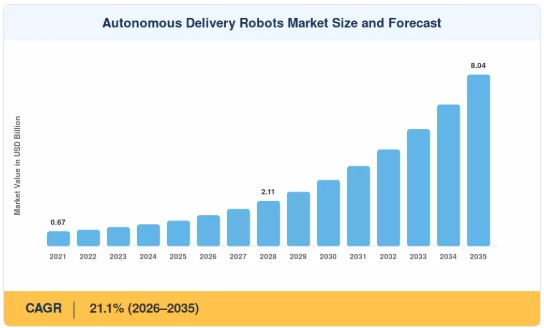
The Autonomous Delivery Robots Market was valued at approximately USD 1.19 billion in 2025 and is projected to rise from USD 1.44 billion in 2026 to USD 8.04 billion by 2035. The industry is expected to register a strong 21.1% CAGR during 2026–2035, driven by growing adoption of autonomous last-mile delivery technologies.
Delivery Robots & Humanoid Robots are emerging as complementary technologies within the broader robotics ecosystem. Autonomous delivery robots are primarily designed for efficient transportation of goods, while humanoid robots are being developed for more flexible interaction and physical task execution. The combination of mobile robotics, artificial intelligence, computer vision, and advanced navigation can expand automation beyond simple package transportation. As humanoid robots become more capable, future logistics environments could integrate multiple robotic systems for receiving, sorting, carrying, and delivering goods.
Get Full PDF Sample Copy of Report: (Including Full TOC, List of Tables & Figures, Chart) @
https://www.marketresearchfuture.com/sample_request/42912
➤ Rising Demand for Last-Mile Automation:
Last-mile delivery remains one of the most expensive and operationally challenging stages of logistics. Autonomous delivery robots can help businesses move small shipments across short distances while reducing dependence on conventional delivery fleets and improving operational flexibility.
Growing online shopping and demand for rapid fulfillment are encouraging retailers, restaurants, and logistics companies to explore automated delivery models. Robot-based transportation can be particularly useful for campuses, neighborhoods, shopping districts, hotels, hospitals, and other controlled environments.
➤ E-Commerce Accelerates Adoption:
The continued expansion of e-commerce is one of the strongest drivers of autonomous delivery robotics. Consumers increasingly expect rapid, convenient, and trackable deliveries, putting pressure on logistics providers to improve fulfillment efficiency.
Autonomous robots can support localized delivery operations by transporting orders from distribution points to customers within relatively short service areas. Their use can also complement human delivery workers by handling repetitive routes and allowing personnel to focus on more complex logistics activities.
➤ What Does the Future Hold for the Autonomous Delivery Robots Market?
Chronic labor shortages in last-mile delivery contribute approximately +3.5 percentage points to the autonomous delivery robots market's CAGR the single highest driver impact. According to the US Bureau of Labor Statistics, delivery-driver turnover exceeded 90% yearly at some large carriers, and the transportation and warehousing sectors had a vacancy rate above 5.8% during 2024. Due to wage competition from gig platforms and an aging workforce, these shortages are structural rather than cyclical. This gap is precisely filled by autonomous ground robots, which work 18-20 hours a day for a fraction of the manpower cost per delivery, and FedEx's Roxo pilot in Houston showed a 35% decrease in per-package delivery costs compared to conventional courier trips.
Rapid LiDAR and sensor cost reductions contribute approximately +3.0 percentage points to the CAGR, establishing hardware deflation as a primary structural driver. Robot fleet economics were revolutionised when solid-state LiDAR modules fell from about USD 10,000 per unit in 2020 to less than USD 500 by late 2024, and manufacturers like Luminar and Hesai have pledged to offer high-volume OEM contracts at prices under USD 300 by 2027. Since the sensor stack accounts for 25-30% of the entire cost of building a robot, lower sensor prices immediately result in faster fleet scale-ups.
E-commerce volume growth and same-day expectations add a further +2.8% as global e-commerce sales surpassed USD 6.3 trillion in 2024 and are projected to reach USD 8 trillion by 2027, with consumer expectations for same-day and sub-two-hour delivery windows putting immense pressure on traditional courier networks. Municipal sidewalk-delivery legislation contributes a further +2.5% as more than 20 US states had enacted or proposed sidewalk-delivery-robot ordinances by the end of 2024, while the European Commission's 2024 update to Regulation (EU) 2019/2144 introduced a harmonized classification for low-speed autonomous delivery vehicles on pedestrian infrastructure.
The next phase of the market's evolution centers on AI-driven autonomy and edge computing, as the next generation of delivery robots relies on transformer-based perception models running on edge processors, reducing reliance on cloud connectivity and enabling robust operation in GPS-denied environments such as indoor malls and underground campuses; NVIDIA's Jetson platform roadmap suggests that on-device inference capability will double every 18 months through 2030.
The market is also gravitating toward a platform-aggregation model where multiple retailers share robot fleets managed by a single operator, much as ride-hailing platforms aggregate driver supply, improving asset utilization from roughly 30% in single-tenant models to above 65% in multi-tenant deployments. Battery technology advances, particularly silicon-anode and solid-state chemistries expected to reach commercial scale by 2028-2030, will extend per-charge range from today's 30 km average to over 80 km, unlocking suburban and peri-urban delivery corridors that current robots cannot serve cost-effectively, while European and North American regulators are tightening last-mile emissions standards under frameworks such as the EU's Urban Logistics Framework, targeting a 60% reduction in urban freight emissions by 2035.
Get access to the full description of the report @
https://www.marketresearchfuture.com/reports/autonomous-delivery-robots-market-42912
➤ Who Are the Key Players in the Autonomous Delivery Robots Market?
The autonomous delivery robots market remains fragmented, with an estimated Herfindahl-Hirschman Index below 800, indicating low concentration. The top five players collectively account for an estimated 22-28% of global fleet deployments. Competition centers on technology differentiation, regulatory access, and delivery-platform partnerships rather than pure scale, allowing venture-backed specialists to compete directly with well-capitalized logistics incumbents. MRFR identifies the following key participants:
• Starship Technologies (~6–8% share)
• Serve Robotics (~5–7% share)
• Nuro (~4–6% share)
• Amazon / Scout Division (~3–5% share)
• Kiwibot (~3–5% share)
• JD.com / JD Logistics (~3–5% share)
• FedEx / Roxo (~2–4% share)
• Ottonomy (~2–3% share)
• Coco Robotics (~1–3% share)
• Refraction AI (~1–2% share)
Strategic competition in the autonomous delivery robots market is increasingly defined by regulatory access and delivery-platform partnerships rather than pure fleet scale, with limited payload capacity and range cited as a top structural headwind, as the majority of commercially used sidewalk robots are limited to small-parcel and food delivery use cases with payloads typically weighing between 10 and 25 kg and battery range constrained to 25-40 km per charge cycle, alongside high upfront fleet capital expenditure ranging from USD 30,000 to USD 150,000 per unit, public safety perception and pedestrian conflicts that can slow municipal permitting by 12-18 months, a fragmented municipal regulatory patchwork, and cybersecurity and data-privacy vulnerabilities.
➤ What Are the Emerging Trends in the Autonomous Delivery Robots Market?
Several transformational trends are redefining the autonomous delivery robots market's evolution through 2035:
Healthcare and Pharmaceutical Logistics: Contact-free medicine delivery lowers the danger of cross-contamination while relieving clinical staff of typical transport duties, with the healthcare end-user market expected to increase at a 26.4% CAGR through 2035, driven in part by aging populations in Germany and Japan placing strain on existing logistics networks.
Robot-as-a-Service and Platform Business Models: Switching from capital-intensive fleet ownership to subscription-based Robot-as-a-Service models lowers the entry barrier for small and mid-size shops, with operators like Cartken and Ottonomy licensing systems to outside delivery aggregators and earning recurring software revenue alongside per-delivery fees.
Emerging-Market Urbanization: Cities across Southeast Asia, Latin America, and the Middle East are undergoing rapid urbanization, concentrating delivery demand in dense corridors ideally suited to ground robots, with Indonesia's e-commerce penetration crossing 30% in 2024 and Brazil's delivery volume growing 22% year-on-year.
Data Monetization and Route Intelligence: Delivery robots equipped with multi-sensor arrays generate continuous geospatial and traffic-pattern data that operators can monetize through partnerships with municipal planning agencies, real-estate developers, and advertising networks, creating ancillary revenue streams beyond per-delivery fees.
Hydrogen Fuel-Cell Integration: Hydrogen-powered propulsion platforms, though currently operating from a small base, are forecast to register a roughly 32% CAGR through 2035 as refueling infrastructure scales, offering longer range and faster refueling compared with lithium-ion batteries for suburban and semi-rural routes.
Buy Full Research Report:
https://www.marketresearchfuture.com/checkout?currency=one_user-USD&report_id=42912
➤ How Is the Autonomous Delivery Robots Market Segmented?
The autonomous delivery robots market report provides a comprehensive segmentation framework:
By Robot Type: Indoor (17.2% CAGR), Outdoor (~61% share, 2025), Hybrid (24.8% CAGR)
By Application: Food Delivery (~45% share, 2025), Grocery & Convenience (22.0% CAGR), Parcel Delivery (USD 0.26 billion, 2025), Other Applications (19.5% CAGR)
By Load Capacity: Up to 10 kg (~50% share, 2025), 10–25 kg (USD 0.28 billion, 2025), 25–80 kg (20.5% CAGR), Above 80 kg (24.2% CAGR)
By End-User Industry: Retail & E-Commerce (~45% share, 2025), Healthcare (26.4% CAGR), Hotels & Hospitality (USD 0.08 billion, 2025), Others (19.0% CAGR)
By Propulsion: Battery-Electric (~87% share, 2025), Hydrogen Fuel Cell (32.0% CAGR), Hybrid Energy Harvesting (USD 0.04 billion, 2025)
By Component: Hardware, Software / AI Stack, Fleet Management Services
By Level of Autonomy: Semi-Autonomous, Fully Autonomous
By Region: North America (~34% share, 2025), Europe (~24% share, 2025), Asia-Pacific (23.5% CAGR), South America (USD 0.12 billion, 2025), Middle East & Africa (USD 0.11 billion, 2025)
➤ Key Market Challenges:
Despite strong growth prospects, autonomous delivery robots face challenges related to safety, navigation, regulations, infrastructure, weather conditions, cybersecurity, and public acceptance. Operating in busy public areas requires reliable obstacle detection and robust decision-making capabilities.
Regulatory differences between cities and countries can also make large-scale deployment difficult. Companies must ensure that robots comply with local transportation, pedestrian safety, data protection, and operational requirements.
➤ Competitive Landscape:
Competition is increasing as robotics developers, logistics companies, technology providers, and delivery platforms invest in autonomous mobility. Companies are focusing on improving navigation, carrying capacity, battery efficiency, security, and fleet-management capabilities.
Strategic partnerships are becoming increasingly important for commercialization. Collaborations among robot manufacturers, retailers, restaurants, logistics providers, universities, and infrastructure operators can help create practical deployment models and accelerate market adoption.
➤ Sustainability Potential:
Autonomous delivery robots may contribute to more sustainable logistics when they replace or complement certain short-distance vehicle journeys. Electric-powered systems can reduce direct emissions in suitable delivery environments while supporting quieter localized transportation.
Their environmental impact ultimately depends on factors such as energy sources, fleet utilization, battery lifecycle, and delivery efficiency. Optimized route planning and high robot utilization can improve the overall sustainability potential of automated delivery networks.
➤ Future Outlook:
The future of the autonomous delivery robotics industry will be shaped by artificial intelligence, improved sensors, 5G connectivity, advanced batteries, and increasingly intelligent fleet-management platforms. Robots are expected to become more reliable, adaptable, and capable of operating across diverse environments.
The integration of Delivery Robots & Humanoid Robots could further expand automation across logistics operations. While delivery robots focus on movement and transportation, humanoid platforms may eventually support loading, unloading, handling, and other physical tasks, creating more connected robotic ecosystems.
➤➤➤ Industry Analysis Reports by Market Research Future:
South Korea Personal Loans Market
https://www.marketresearchfuture.com/reports/south-korea-personal-loans-market-44835
India Smartphone Market
https://www.marketresearchfuture.com/reports/india-smartphone-market-46147
Italy Smartphone Market
https://www.marketresearchfuture.com/reports/italy-smartphone-market-46145
Malaysia Smartphone Market
https://www.marketresearchfuture.com/reports/malaysia-smartphone-market-46143
Japan Wireless Connectivity Market
https://www.marketresearchfuture.com/reports/japan-wireless-connectivity-market-46967
South Korea Service Robotics Market
https://www.marketresearchfuture.com/reports/south-korea-service-robotics-market-48755
Russia Service Robotics Market
https://www.marketresearchfuture.com/reports/russia-service-robotics-market-48763
China Service Robotics Market
https://www.marketresearchfuture.com/reports/china-service-robotics-market-48761
South Korea Virtual Reality Gaming Market
https://www.marketresearchfuture.com/reports/south-korea-virtual-reality-gaming-market-49020
Europe Investment Banking Market
https://www.marketresearchfuture.com/reports/europe-investment-banking-market-55170
Market Research Future
Market Research Future
+ +1 855-661-4441
email us here
Legal Disclaimer:
EIN Presswire provides this news content "as is" without warranty of any kind. We do not accept any responsibility or liability for the accuracy, content, images, videos, licenses, completeness, legality, or reliability of the information contained in this article. If you have any complaints or copyright issues related to this article, kindly contact the author above.
