

Fluoropolymer Barrier Films & Pharmaceutical Packaging Market to Reach USD 12,215.39 Million at 6.83% CAGR
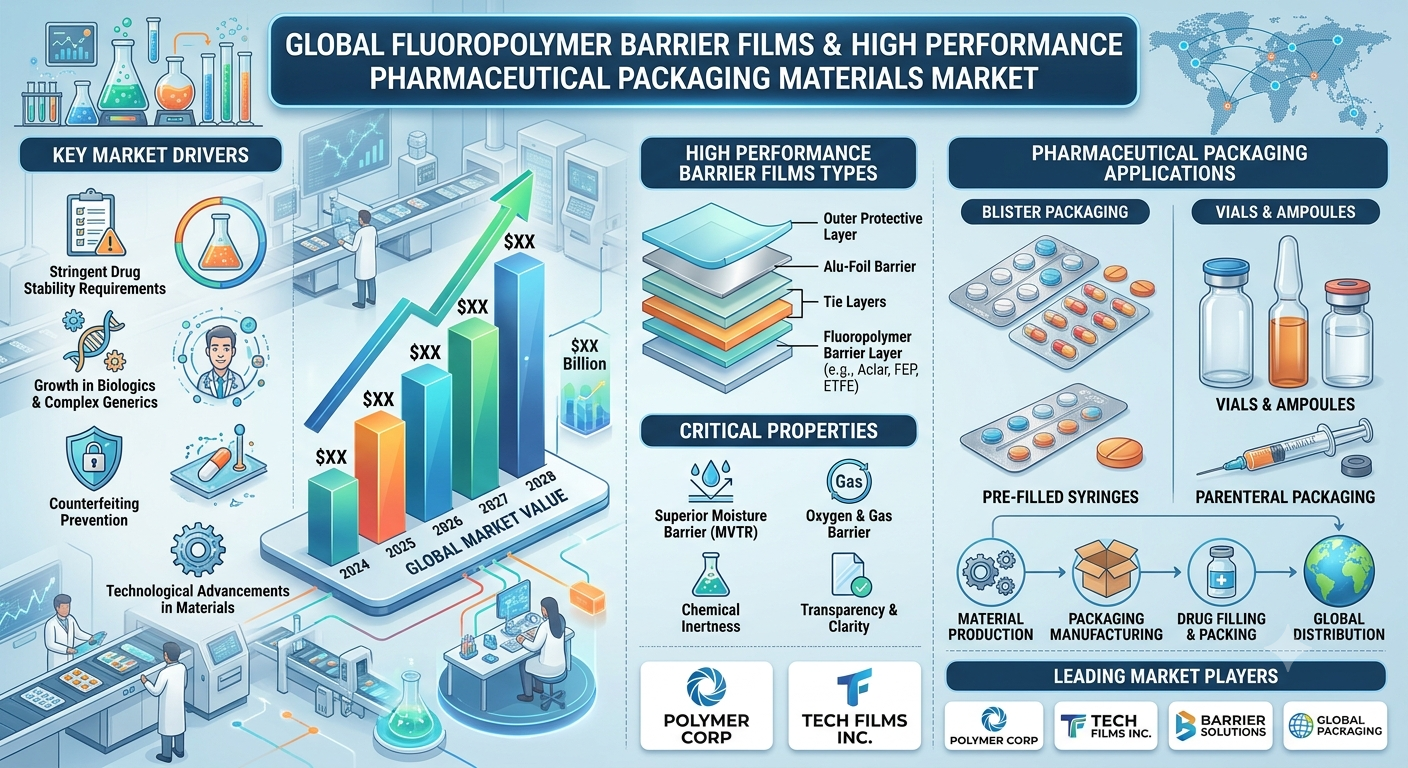
Fluoropolymer Barrier Films & High Performance Pharmaceutical Packaging Materials Market
North America dominated the global market in 2025 with revenues of USD 2,066.39 million, representing approximately 32.8%
TX, UNITED STATES, August 28, 2026 /EINPresswire.com/ -- The Fluoropolymer Barrier Films & High Performance Pharmaceutical Packaging Materials Market is gaining momentum as pharmaceutical manufacturers increasingly require advanced packaging capable of protecting sensitive medicines from moisture, oxygen, light, temperature fluctuations, and chemical exposure. High-performance barrier materials are becoming particularly important for biologics, biosimilars, vaccines, injectables, and other specialty therapies where packaging integrity directly influences product stability and shelf life.The global fluoropolymer barrier films and pharmaceutical packaging materials market was valued at approximately USD 6,309.11 million in 2025 and is projected to reach USD 12,215.39 million by 2035, expanding at a compound annual growth rate (CAGR) of 6.83% over the forecast period (2026–2035).
Rising Demand for High-Barrier Pharmaceutical Packaging
The pharmaceutical industry's shift toward complex and sensitive medicines is a major growth factor for the market. Biologics, monoclonal antibodies, peptide therapies, mRNA-based products, vaccines, and advanced therapies often require packaging with significantly stronger protective properties than conventional polymer packaging.
Moisture and oxygen exposure can negatively affect pharmaceutical stability. Consequently, manufacturers are increasingly adopting high-barrier films and specialized packaging structures that provide stronger protection throughout manufacturing, storage, transportation, and distribution.
Fluoropolymer materials are particularly attractive because of their chemical resistance and barrier performance. This makes them suitable for demanding pharmaceutical applications where product quality and shelf life are critical.
Biologics Accelerate Advanced Packaging Adoption
The expanding global pipeline of biologics and biosimilars is creating substantial opportunities for high-performance packaging manufacturers. These products can be highly sensitive to environmental conditions and frequently require carefully controlled packaging and distribution systems.
The market data indicates that Biopharmaceutical & Advanced Healthcare applications are expected to grow at a 7.85% CAGR, making them one of the fastest-growing application categories.
The increasing use of prefilled syringes, specialized vial systems, auto-injectors, and other drug-delivery formats is also increasing demand for advanced barrier components.
As pharmaceutical companies invest in higher-value therapies, the cost of sophisticated packaging becomes a smaller consideration compared with the potential financial impact of product degradation, contamination, or recalls.
Download Report Sample Copy with TOC: https://www.marketresearchfuture.com/sample_request/68387
Barrier Films Hold a Leading Position
By product type, the market includes Barrier Films, Flexible Pharmaceutical Packaging Structures, and Rigid & Semi-Rigid Pharmaceutical Containers.
Barrier films represented the largest product category in 2025, with a market value of approximately USD 2.85 billion. These materials are used in blister packs, pouches, laminates, and other pharmaceutical packaging formats.
Meanwhile, rigid and semi-rigid pharmaceutical containers are projected to be the fastest-growing product category, registering a 7.88% CAGR. Growth is being supported by increasing demand for injectable products, prefilled syringes, cartridges, and high-performance vial components.
This shift demonstrates the increasing importance of packaging solutions designed specifically for advanced drug-delivery systems.
PFA Films Maintain Strong Demand
The fluoropolymer segment includes PTFE, PVDF, FEP, ETFE, PFA, PCTFE, ECTFE, and specialty fluoropolymers.
PFA films represented the dominant fluoropolymer category in 2025, with a market value of approximately USD 443.23 million. PFA offers chemical resistance and thermal stability, making it suitable for demanding pharmaceutical packaging environments.
Specialty and other fluoropolymer formulations are developing rapidly, with the segment projected to grow at approximately 10.64% CAGR. This growth reflects increasing demand for materials engineered for specific pharmaceutical applications and advanced therapies.
Flexible Pharmaceutical Packaging Remains Important
Flexible pharmaceutical packaging represents a major application area because of the widespread use of pouches, sachets, strip packs, and other flexible formats.
The flexible pharmaceutical packaging application segment was valued at approximately USD 2.04 billion in 2025, making it the largest application category.
Flexible packaging offers benefits such as lightweight construction, efficient material utilization, convenient handling, and compatibility with a broad range of pharmaceutical products.
As pharmaceutical manufacturers seek packaging that balances protection, cost, convenience, and sustainability, high-performance flexible structures are expected to remain an important market segment.
Blister Packaging Creates New Opportunities
Blister packaging is another major area of opportunity. Traditional packaging materials may not always provide the barrier performance required for moisture-sensitive medicines and stability-critical formulations.
Fluoropolymer-based barrier structures can improve protection against environmental exposure while maintaining the flexibility and processing characteristics required for pharmaceutical packaging.
The adoption of advanced blister films is particularly relevant in regions with humid or tropical climates, where moisture protection can be especially important.
Asia-Pacific is emerging as an important growth center as pharmaceutical production and generic-drug manufacturing expand across China, India, and Southeast Asia.
Buy Now: https://www.marketresearchfuture.com/checkout?currency=one_user-USD&report_id=68387
Cold-Chain Expansion Supports Market Growth
The expansion of pharmaceutical cold-chain infrastructure is another significant growth driver. Temperature-sensitive products require packaging capable of maintaining integrity during storage and transportation.
The pharmaceutical supply chain is becoming increasingly global, with medicines frequently transported across long distances before reaching healthcare providers and patients.
High-performance packaging materials can help protect products from environmental exposure during transportation and support the reliability of temperature-controlled distribution systems.
Emerging pharmaceutical manufacturing regions are investing heavily in cold-chain infrastructure, creating additional demand for durable and compliant packaging solutions.
Barrier Enhancement Technologies Gain Momentum
Technology is becoming increasingly important across the industry. Conventional film manufacturing and conversion remain dominant, representing approximately USD 4.25 billion in 2025, but barrier enhancement technologies are growing rapidly at a 7.55% CAGR.
Advanced technologies include coating, plasma treatment, vacuum deposition, and other techniques designed to improve moisture, oxygen, light, and chemical resistance.
The development of thinner barrier layers is also attracting attention because manufacturers want to reduce material consumption while maintaining high performance.
Hybrid structures that combine fluoropolymer layers with inorganic coatings such as SiOx and AlOx may further expand the performance capabilities of pharmaceutical packaging.
Sustainability Reshapes Material Development
Sustainability is becoming an increasingly important consideration for pharmaceutical packaging manufacturers. Regulators, pharmaceutical companies, and consumers are placing greater emphasis on recyclable materials, lower environmental impact, and responsible manufacturing.
The development of recyclable and lower-impact fluoropolymer barrier solutions represents an important opportunity for the industry. Manufacturers are exploring ways to maintain high barrier performance while reducing material complexity and environmental impact.
The transition toward more sustainable packaging could encourage innovation in mono-material structures, PFAS-free alternatives, recyclable barrier films, and lower-impact production processes.
High Material Costs Remain a Challenge
Despite strong growth prospects, high material and conversion costs remain a major market restraint. Fluoropolymer resins can be considerably more expensive than conventional polymers, making them less attractive for price-sensitive pharmaceutical products.
Specialized manufacturing processes such as precision co-extrusion, advanced coating, plasma treatment, and vacuum deposition can further increase production costs.
As a result, high-performance fluoropolymer packaging is particularly attractive for high-value medicines where packaging performance is more important than minimizing material costs.
Manufacturers are therefore working to improve production efficiency and develop formulations that deliver high performance at more competitive costs.
Report Summary: https://www.marketresearchfuture.com/reports/fluoropolymer-barrier-films-high-performance-pharmaceutical-packaging-materials-market-68387
Regulatory Requirements Influence Innovation
Pharmaceutical packaging is subject to stringent regulatory requirements. Materials must undergo extensive testing for extractables and leachables, container-closure integrity, stability, compatibility, and other performance characteristics.
These requirements can lengthen the qualification process for new packaging materials. Manufacturers must demonstrate that new materials do not compromise drug safety, quality, or efficacy.
Although regulatory requirements can slow commercialization, they also create opportunities for suppliers with established compliance records and strong technical capabilities.
Asia-Pacific Emerges as the Fastest-Growing Region
Asia-Pacific is expected to be the fastest-growing regional market, with an estimated 8.31% CAGR through 2035. Pharmaceutical manufacturing capacity in China, India, and Southeast Asia is expanding, supporting demand for advanced packaging materials.
The region's strong generic-drug manufacturing base is particularly important. Pharmaceutical companies seeking to serve regulated international markets increasingly require packaging that meets demanding quality and stability standards.
Growing healthcare investment, expanding biologics production, and cold-chain development are expected to provide additional opportunities.
North America Maintains Market Leadership
North America was the dominant regional market in 2025, generating approximately USD 2.07 billion in revenue.
The region benefits from a large pharmaceutical and biopharmaceutical industry, advanced healthcare infrastructure, and stringent regulatory requirements.
The United States represents the primary market, supported by significant investment in biologics, specialty medicines, injectable therapies, and advanced drug-delivery systems.
Demand for prefilled syringes, high-performance vials, and specialized barrier packaging is expected to continue supporting regional growth.
Europe Focuses on Sustainable Packaging
Europe was valued at approximately USD 1.73 billion in 2025 and remains an important market for high-performance pharmaceutical packaging.
The region's strong pharmaceutical industry and strict regulatory environment are encouraging manufacturers to improve packaging performance while addressing sustainability concerns.
Interest in recyclable structures, PFAS alternatives, and lower-impact materials is expected to influence product development across the region.
Competitive Landscape
The competitive environment includes major companies such as Daikin Industries, DuPont, Saint-Gobain, Honeywell International, Arkema, West Pharmaceutical Services, Caprihans India, ACG, Guarniflon, and Tekni-Plex.
Competition is centered on barrier performance, chemical resistance, regulatory compliance, manufacturing capabilities, sustainability, and geographic reach.
Leading companies are increasingly investing in material science, advanced film conversion, specialized pharmaceutical packaging, and sustainable product development.
Vertical integration is also becoming more important as fluoropolymer manufacturers expand into downstream film production and pharmaceutical packaging applications.
Similar Report
Fluoropolymer Additives Market https://www.marketresearchfuture.com/reports/fluoropolymer-additives-market-8050
Fluoropolymer Lined Pipes & Fittings Market https://www.marketresearchfuture.com/reports/fluoropolymer-lined-pipes-fittings-market-22177
Filled Fluoropolymer Market https://www.marketresearchfuture.com/reports/filled-fluoropolymer-market-10715
Fluoropolymer Coating Market https://www.marketresearchfuture.com/reports/flouropolymer-coating-market-4844
fluoropolymer masterbatch market https://www.marketresearchfuture.com/reports/fluoropolymer-masterbatch-market-28396
fluoropolymer processing aid market https://www.marketresearchfuture.com/reports/fluoropolymer-processing-aid-market-30569
Market Research Future
Market Research Future
+ +1 855-661-4441
email us here
Legal Disclaimer:
EIN Presswire provides this news content "as is" without warranty of any kind. We do not accept any responsibility or liability for the accuracy, content, images, videos, licenses, completeness, legality, or reliability of the information contained in this article. If you have any complaints or copyright issues related to this article, kindly contact the author above.
