

Organic Tea Market Set to Hit USD 4.97 Billion by 2035, Driven by Wellness and Traceability
Stricter EU organic rules and India's value-chain initiatives are strengthening certified supply as consumers increasingly seek traceable, clean-label tea.
Organic tea is evolving from a niche premium product into a globally scalable beverage category driven by wellness, traceability and certified sustainable sourcing.”
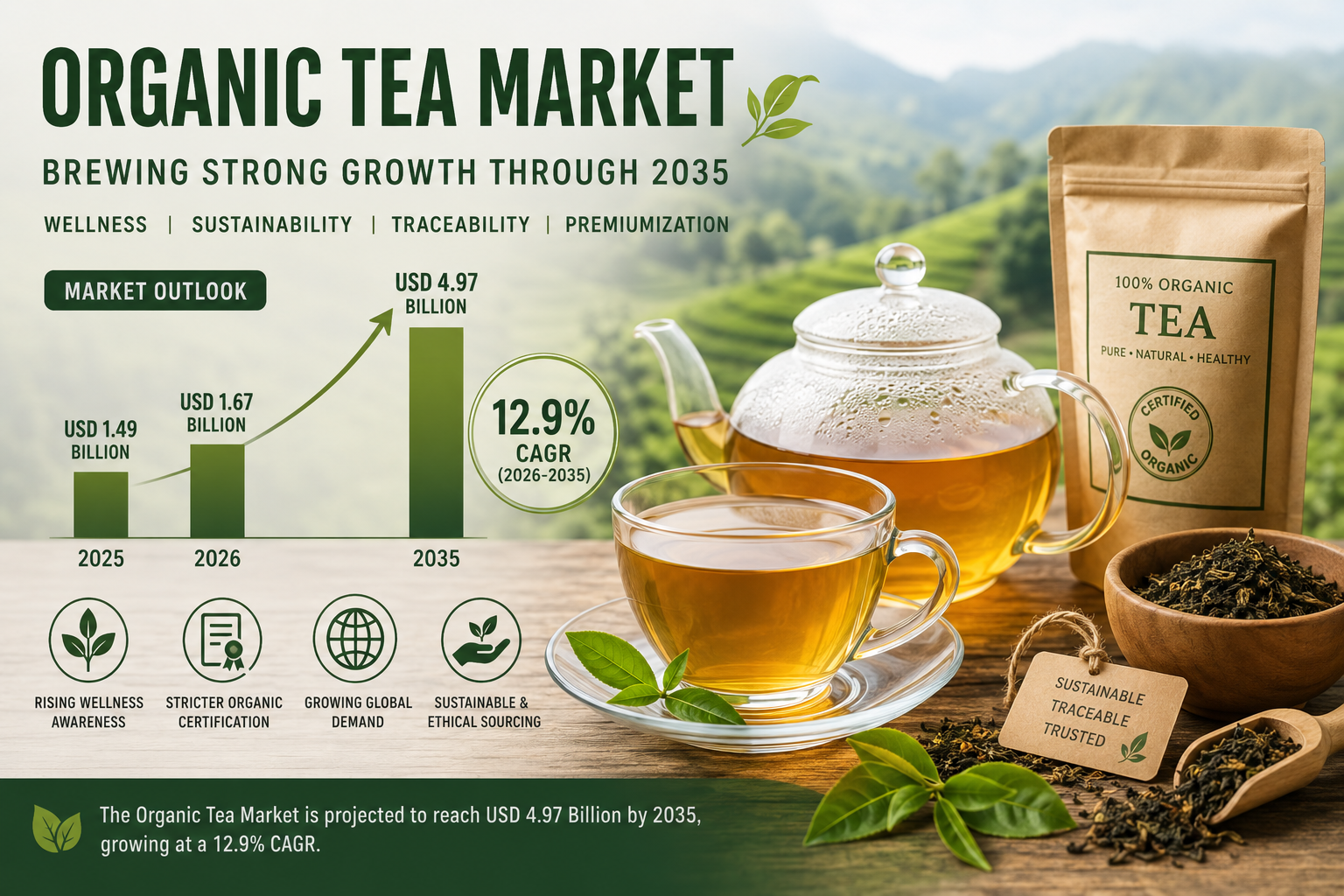
NEW YORK, NY, UNITED STATES, August 31, 2026 /EINPresswire.com/ -- The global Organic Tea Market is entering a high-growth decade, with market value projected to increase from USD 1.49 billion in 2025 to USD 1.67 billion in 2026 and reach USD 4.97 billion by 2035, registering a 12.9% compound annual growth rate (CAGR) during the 2026–2035 forecast period, according to Market Research Future.— Market Research Future (MRFR)
The market's expansion reflects a structural shift in how consumers, retailers and foodservice operators evaluate tea. Organic certification, clean-label expectations, wellness-oriented consumption, supply-chain transparency and growing interest in responsible agricultural production are moving organic tea from a premium niche toward a broader global beverage category.
Two forces are particularly important to the industry's long-term trajectory: the strengthening of organic import and certification requirements in major markets, and continued investment in certified production and value-chain infrastructure at origin. In Europe, Regulation (EU) 2018/848 has applied since January 2022, establishing strengthened rules for organic production, labelling, controls and trade. In India, the Mission Organic Value Chain Development initiative has supported the development of certified organic production clusters and end-to-end value chains, particularly across the country's important agricultural regions.
Organic Certification Becomes a Competitive Advantage
Organic certification is increasingly becoming more than a marketing claim. It is evolving into a core commercial requirement for brands seeking access to premium retailers, specialist stores and international markets.
The European Union's organic framework has strengthened requirements covering production, certification, controls and imports. For organic products entering the European market, operators must meet applicable EU organic requirements or qualify under recognized equivalence arrangements and control systems.
For tea producers and exporters, this regulatory environment is increasing the importance of farm-level documentation, certification management, traceability and supply-chain controls. While these requirements can increase compliance costs, they also create a higher barrier to entry for suppliers unable to demonstrate consistent organic credentials.
Get Full PDF Sample Copy of Report: (Including Full TOC, List of Tables & Figures, Chart) @ https://www.marketresearchfuture.com/sample_request/3139
The result is a market in which verified supply increasingly commands strategic value.
Retailers are also placing greater emphasis on transparency. Consumers are becoming more interested in where tea originates, how it is cultivated, what certification applies to it and whether environmental and social claims can be substantiated.
This development favors producers and brands capable of connecting certified agricultural production with reliable documentation, consistent quality and transparent origin stories.
India's Organic Value Chain Development Supports Certified Supply
India represents an important supply-side opportunity for the global organic tea industry.
The country's organic production ecosystem includes major tea-producing regions such as Assam, Darjeeling and the Nilgiris, each associated with distinctive growing conditions, tea profiles and established international recognition.
Market Research Future identifies India's Mission Organic Value Chain Development as an important catalyst for the Organic Tea Market and reports approximately USD 190 million in investment associated with certified cluster development. The broader government program has focused on building organic value chains linking growers with consumers through inputs, certification, collection, aggregation, processing, marketing and brand development.
Government information on the Mission Organic Value Chain Development for the North Eastern Region describes its objective as developing certified organic production through a value-chain approach, including support for farmer clusters, certification, processing, aggregation, marketing and brand building.
Such initiatives are strategically important because organic tea growth depends not only on consumer demand but also on the availability of reliable certified leaf.
For smallholders, certification can be challenging because audit, documentation, transition and internal-control requirements create costs that are easier to absorb when farmers participate in organized clusters or producer organizations. Value-chain programs can therefore help aggregate supply while improving access to certification and downstream markets.
The long-term opportunity extends beyond exporting bulk tea. Origin countries can capture greater value by developing branded products, specialty blends, packaged tea, functional infusions and direct-to-consumer channels.
Wellness and Clean-Label Consumption Expand the Addressable Market
Consumer behavior is another major growth engine.
Tea has traditionally occupied a strong position as a daily beverage, but the organic segment is increasingly being connected with broader wellness and clean-label trends. Consumers are looking for beverages perceived as natural, responsibly produced and compatible with healthier lifestyles.
Organic tea benefits from this shift because the product itself is relatively simple: consumers can easily understand the connection between the tea leaf, agricultural practices and the finished beverage.
Green organic tea remains a leading category. Market Research Future estimates that green organic tea accounted for 36.8% of 2025 market share, supported by consumer interest in wellness-oriented positioning and established familiarity with green tea.
At the same time, herbal and fruit infusions are emerging as a particularly dynamic segment. Market Research Future projects the category to expand at approximately 14.2% CAGR through 2035, as consumers seek caffeine-free products and new consumption occasions.
This creates opportunities for brands to develop organic blends featuring botanicals, fruits, spices and other naturally positioned ingredients.
However, brands must distinguish between wellness-oriented positioning and regulated health claims. The strongest products are likely to combine appealing sensory profiles, credible organic certification, transparent ingredient information and responsible communications rather than relying on unsupported therapeutic claims.
Premiumization Creates New Revenue Opportunities
Organic tea is also benefiting from premiumization.
Single-origin products, estate-specific teas, specialty green teas, rare lots and carefully developed herbal blends can command higher prices when supported by credible provenance and quality.
This premiumization trend is particularly relevant in Europe and North America, where consumers are accustomed to paying more for certified organic products and specialty beverages.
Market Research Future reports that Europe is projected to record the fastest regional growth, with a 13.2% CAGR between 2026 and 2035. Asia-Pacific, meanwhile, held the largest regional share in 2025 at 38.8%, reflecting the region's combined importance as both a production base and a growing consumer market.
The divergence creates an important international opportunity: producing regions can increasingly move from supplying commodity leaf toward capturing value through branded and differentiated products, while mature consumer markets continue to support premium organic positioning.
Hospitality and On-Trade Channels Add Momentum
The organic tea opportunity is not limited to grocery stores and e-commerce.
Cafés, hotels, restaurants, premium hospitality venues and corporate foodservice are becoming important channels for organic tea discovery. Market Research Future estimates that the on-trade channel is advancing at approximately 14.8% CAGR, faster than traditional retail channels.
Hospitality provides brands with an opportunity to communicate provenance directly to consumers. A menu description can highlight the origin, certification and character of a tea, while premium service formats can support higher per-serving prices.
Hotels and premium hospitality operators can also use organic tea as part of broader sustainability and wellness programs.
The category therefore benefits from a reinforcing cycle: consumers encounter premium organic tea in hospitality environments, develop familiarity with the product and subsequently seek similar products through retail or online channels.
Packaging Is Becoming Part of the Organic Tea Proposition
Packaging is another area where market expectations are changing.
Organic consumers increasingly evaluate not only the contents of a product but also the environmental implications of its packaging. Recyclable cartons, paper-based formats, refill systems, compostable materials and reduced-plastic designs are gaining attention.
Market Research Future reports that cartons represented 32.2% of packaging revenue in 2025, reflecting their combination of shelf visibility, recyclability and space for certification and product information.
Packaging can also play a critical role in communicating provenance. QR codes and digital product pages can connect consumers with information about origin, certification, production methods and batch details.
As traceability becomes increasingly important, packaging is evolving from a simple protective layer into a consumer-facing information platform.
Digital Traceability Strengthens Consumer Confidence
Technology is emerging as another defining feature of the organic tea supply chain.
Traditional paper-based records can make it difficult to provide consumers and buyers with detailed information about individual lots. Digital traceability systems can connect farms, processors, exporters, importers, warehouses and retailers through shared supply-chain data.
Blockchain-backed tracking, digital certificates, QR-linked batch information, laboratory testing and farm-level mapping are among the technologies being explored across agricultural supply chains.
For organic tea, these technologies can help address one of the category's most important commercial questions: whether the product's organic and origin claims can be verified.
The shift toward digital provenance is likely to favor companies that invest in supply-chain visibility before such capabilities become mandatory requirements from retailers or regulators.
Supply Constraints Remain a Key Market Challenge
Despite strong demand prospects, the Organic Tea Market faces several constraints.
Certification costs can be substantial for small farms and estates. Producers may also face a transition period during which agricultural practices change before they can fully realize organic-market premiums.
Organic cultivation can require additional labor for weed management, biological pest control and soil-management practices. Weather volatility and climate-related changes can further complicate production planning.
These challenges create a potential supply-demand imbalance. If certified production does not expand sufficiently, premium prices may remain elevated and restrict organic tea penetration in price-sensitive markets.
For this reason, investment in farmer training, group certification, agronomic support, processing infrastructure and long-term procurement agreements will be critical.
Buyer-funded transition programs can also provide a mechanism for brands and retailers to secure future certified supply while helping growers manage the economics of conversion.
Asia-Pacific Remains Central to the Market's Future
Asia-Pacific is expected to remain at the center of organic tea development through 2035.
The region combines major tea-producing countries with increasingly sophisticated consumer markets. India, China, Japan, Sri Lanka and other Asian markets provide a diverse production and consumption ecosystem.
India's position is particularly significant because of its established tea heritage and the presence of globally recognized growing regions.
Japan's premium tea culture creates opportunities for certified green tea and specialty products, while China's large domestic tea market offers significant potential for premiumization.
Across Southeast Asia, organic conversion, specialty agriculture and direct-to-consumer commerce can create additional growth pathways.
The region's long-term competitive advantage will increasingly depend on the ability to connect agricultural origin with certification, processing quality, brand development and international distribution.
Europe Leads in Certification-Driven Demand
Europe is positioned as one of the most important high-value markets for organic tea.
The region's established organic retail infrastructure and consumer familiarity with certification provide a favorable environment for premium products. Germany, France, the United Kingdom, Italy and Nordic markets represent important opportunities across grocery, specialty retail, foodservice and e-commerce.
The EU regulatory framework is simultaneously increasing the importance of supply-chain compliance.
For exporters, this means that successful market participation will increasingly depend on accurate certification documentation, reliable controls and transparent supply-chain information.
For retailers, the development creates opportunities to differentiate products through credible origin and sustainability narratives rather than relying solely on generic “natural” positioning.
Competitive Landscape Favors Differentiated Brands
The global organic tea industry remains relatively fragmented, with multinational tea groups, established specialty brands, herbal-infusion companies, origin-focused businesses and private-label retailers competing across multiple categories.
Large companies bring distribution, purchasing scale and international retail relationships. Smaller brands can compete through single-origin sourcing, specialty formulations, sustainability credentials and direct relationships with growers.
Private-label organic tea is also becoming more significant, particularly in developed markets. This can place pressure on branded products in mainstream price tiers.
Differentiation will therefore become increasingly important.
Brands that simply offer a conventional tea product with an organic certification may face greater price competition. Companies that combine certified sourcing with strong provenance, distinctive taste profiles, functional positioning, sustainable packaging and direct consumer engagement may have greater opportunities to protect margins.
Outlook Through 2035
The Organic Tea Market is moving into a period in which growth will be defined by both demand and verification.
The projected increase from USD 1.49 billion in 2025 to USD 4.97 billion by 2035 represents more than a numerical expansion of the category. It reflects a broader transformation in the relationship between consumers and agricultural products.
Organic tea is increasingly expected to demonstrate what it claims.
Certification must be credible. Origin must be traceable. Sustainability statements must become more measurable. Packaging must respond to environmental expectations. Producers need access to financing and technical support. Brands need to communicate value without overstating health benefits.
At the same time, the fundamentals remain favorable. Tea is a globally established beverage, organic consumption continues to benefit from clean-label and wellness trends, and digital commerce is making specialized products accessible to consumers well beyond traditional specialty stores.
Green tea is expected to remain a major category, while herbal and fruit infusions provide a faster-growing avenue for innovation. Premium hospitality, specialty retail, e-commerce, gifting and origin-branded products offer additional pathways for value creation.
For producers, processors, brands, retailers and investors, the strategic priority is increasingly clear: build certified supply, strengthen traceability and create products that give consumers a compelling reason to pay for verified organic value.
As the industry approaches 2035, the companies best positioned for growth are likely to be those that can connect certified production at origin with transparent supply chains, differentiated products and trusted consumer brands.
With a projected 12.9% CAGR from 2026 to 2035, the Organic Tea Market is positioned to become an increasingly important segment of the global premium and wellness beverage economy.
Discover Related Research Reports By Market Research Future:
Tea Market
https://www.marketresearchfuture.com/reports/tea-market-2155
Matcha Tea Market
https://www.marketresearchfuture.com/reports/matcha-tea-market-2382
Functional Tea Market
https://www.marketresearchfuture.com/reports/functional-tea-market-3122
Market Research Future
Market Research Future
+1 855-661-4441
email us here
Legal Disclaimer:
EIN Presswire provides this news content "as is" without warranty of any kind. We do not accept any responsibility or liability for the accuracy, content, images, videos, licenses, completeness, legality, or reliability of the information contained in this article. If you have any complaints or copyright issues related to this article, kindly contact the author above.
